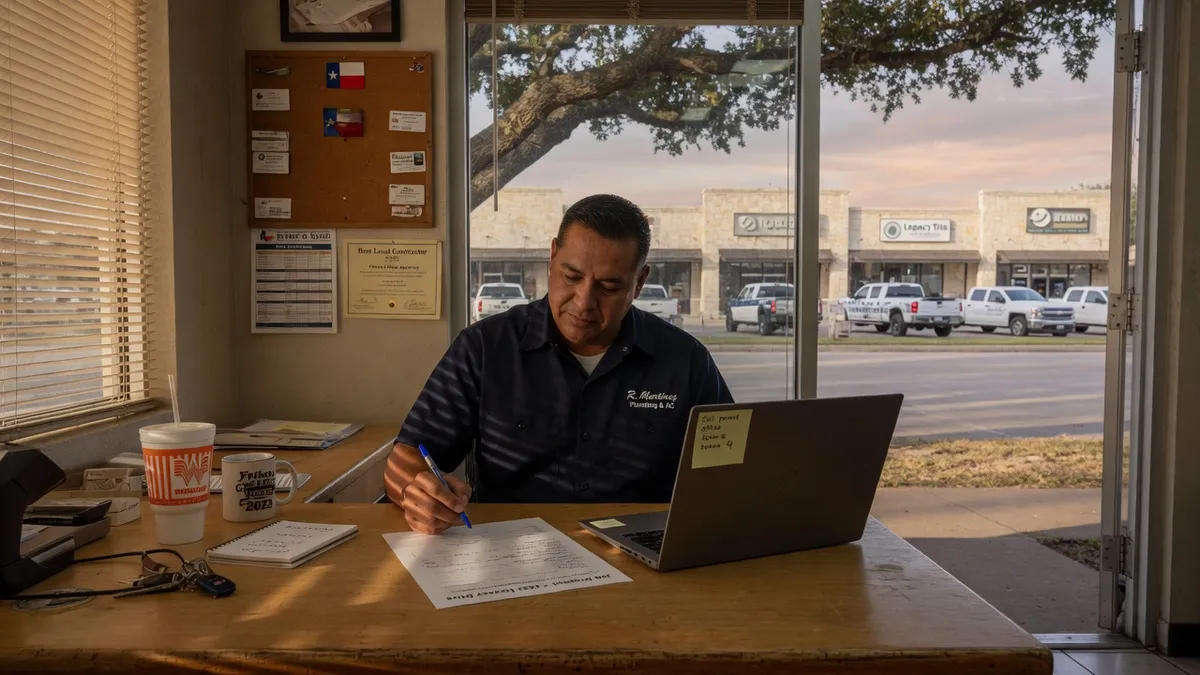
Use AI to draft your about page, then keep only facts you can say out loud. A check for trades owners.
The about page proves that the person who answers the phone is the same business the buyer already saw. Owners lose that proof in two ways. The page is three lines of "family owned, quality work, customer first," which could belong to any shop. Or it is a long model draft that invented a founding year, a crew size, a license number, a family story, and a promise you have never made on a job.
AI is a fast drafter and a sharp editor here. It is a poor owner of the facts. You own the facts. If a sentence is not true on a Tuesday in the truck, it does not belong on the page.
This is a writing pass, not a ranking promise. A clear page helps a buyer decide. It does not create jobs by itself. At Ethical AI in Frisco, the model may draft, and a person signs the facts.
What the page has to do
A buyer opens About for three checks.
Who shows up. Say the role in plain words: owner-operator, a two-person crew, a lead tech and an apprentice. Skip the brand voice.
Where the work happens, and where it does not. Service area is a boundary, not a list of towns. Name the area you will drive this month. If you decline a job type, say so in one line. A limit is more believable than a claim that you do everything.
Whether the story matches your other public records. Your business profile, your small business listings, and this page should agree on the public name, the services, the hours, and the area. When they disagree, the buyer hesitates. Fix that in your own words before you ask a model to make the page sound professional.
How to ask for a review stays off this page. After the job, name the work the customer saw and ask for an honest account in their words. The about page only has to make that shop recognizable. Do not publish language for a customer to paste.
Write the fact sheet first
Fill a notes page with only what you can say out loud. Leave a blank where you are unsure. A blank is allowed. A guess is not.
One line each:
- Public name, spelled as it is on the truck and on the business profile. - Legal name, only if you want it public. Many shops leave it off. - Your role. "Owner" is enough. A childhood story only if it is true and short. - The year you will print. If you took the shop over, say so. Do not keep the prior owner's start date as yours. - Crew shape today. People who go to jobs, not people you hope to hire. - Services you will book this month, and services you decline. - The area you drive, in one or two sentences. No city paragraph. - License or registration, copied from the card. - Hours, and whether you take after-hours calls. If you do not, write "no." - How a job starts: call, photos, visit, written price, deposit. Match what you already do. - One true detail of how you work. Shoe covers. A photo before you leave. A price before you open the wall. - A refusal list: "best in town," "number one," "fully insured" if you will not name the coverage, any award you cannot point to, any city you will not drive to.
Empty lines stay empty. The first instruction to every model is: do not invent, do not estimate, and do not borrow a typical story from other shops.
Run the draft in passes
Use the models as stations. Paste the same sheet and the same refusal list each time. Ask for short sentences, no slogans, and blanks left blank.
Put this above the sheet:
"Write an about page from this fact sheet only. Use plain sentences a buyer can skim on a phone. Skip any blank line. Do not add years, crew size, awards, hours, licenses, service area, or a family story. Keep every limit I listed. Mark any sentence you are tempted to add with the word CHECK."
Delete every CHECK before the page goes up.
**Claude** writes the first draft from the sheet alone. If it adds a mood the sheet did not earn, send the sheet and the instruction back unchanged.
**GPT** tightens the draft for a buyer who stays less than a minute. Put who you are, what you do, and what you will not do in the first short block. Cut repeated claims. Add nothing.
**Grok** reads it the way a careful buyer would, on the driveway. Ask for two lists only: sentences that could belong to any shop in the trade, and claims that are not on the sheet. You decide what stays. Do not accept a smoother rewrite that smuggles in a new promise.
**Gemini** checks the draft against the business profile and the other small business listings: public name, services, hours, and area, including punctuation. Fix the surface that is wrong. Do not let the model invent a third version.
**Perplexity** confirms a fact you already mean to claim, such as a license record you will cite, or a sentence already on your own site. A confident summary is not a new fact. If you cannot see a source you trust, leave the sentence off.
Don't have Claude? No problem. Start at GPT. Don't have GPT? No problem. Start at Grok or Gemini. Don't have Grok, Gemini, or Perplexity? No problem. One model can draft. You still do the skeptic pass yourself, sheet on the bench. Five tools do not make a truer page. The sheet does.
When you have them, keep this order: Claude, then GPT, then Grok, then Gemini, then Perplexity. Draft, tighten, doubt, match the listings, then confirm a source. Skipping ahead to "make it punchy" is how a founding year gets invented.
A worked example
This is a worksheet, not a client and not a result. The sheet says: owner and one apprentice; started 2019 after leaving a larger crew; this month, panel upgrades, troubleshooting, and home charger installs; no new commercial build-outs; weekday drives under 40 minutes from the shop; license copied from the card; Monday to Friday, 7 to 4; no after-hours; photos by text, then a written price before work; shoe covers indoors; no "fastest," no "cheapest," no list of cities.
A weak draft sounds like this: "This shop has proudly served the entire metro for decades, with award-winning residential and commercial work and round-the-clock response."
The area grew, 2019 became decades, declined commercial work came back, and an award appeared from nowhere.
The corrected opening is enough:
"We are an owner and an apprentice. We started in 2019. We upgrade panels, troubleshoot faults, and install home chargers. We do not take new commercial build-outs. We work Monday to Friday, 7 to 4, and we do not run after-hours calls. You send photos, we send a written price, and we wear shoe covers inside."
Compare that paragraph to the sheet line by line. If a line is not on the sheet, delete it.
What to check before the page goes up
Read the draft out loud. Then check these with the sheet in your hand.
- The public name matches the truck, the business profile, and the other listings. - Any year is one you can explain in a sentence. - Headcount matches who went to jobs this month. - Every service is one you will book this month. - Every limit is still there. Models delete limits because limits feel negative. - Hours match the profile. If the profile is wrong, fix it or fix the page. Do not publish the conflict. - License numbers match the card character for character. - The area is still the boundary you drive. - A review quote appears only if you can open the real review and the words match. - Nothing promises a rank, a "best in town" title, or income from the page.
If the sheet is blank on an item, that sentence should already be gone.
What to leave out
Leave out slogans any competitor could paste, awards you cannot show, a string of city names, review scripts, someone else's history, and prices. "Your satisfaction is our priority" is not information. One honest boundary is the whole geography. A short true history beats a borrowed story about a family truck. This page is not a menu.
Put it up, then keep the sheet
Paste the final version in yourself. Read it on your phone in the driveway. Change the sentence that still sounds like a brochure.
If a listing or the business profile still disagrees, fix the wrong surface before you call the page finished. AI can draft the page. It should not pick which version of the business is real.
Keep the sheet. When hours, crew, or services change, edit the sheet first and run the same passes.
For a second set of eyes on the sheet and the draft, book a short call. Bring both. We will mark what is solid and what still sounds borrowed.
Ethical AI · Frisco, TX · 469-669-2728