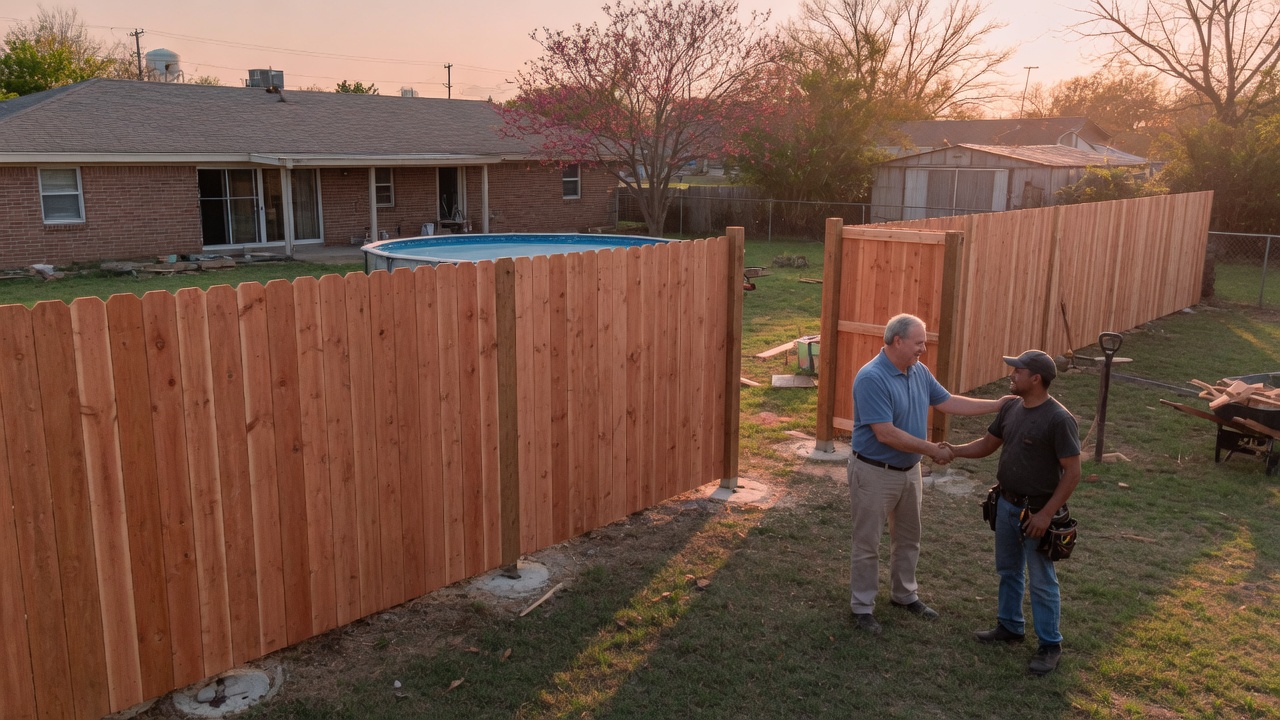
Use AI to caption job photos. Do not generate fake jobs.
The photo has to be a job you did. The model can write the caption and the alt text. A named person posts it. Do not ask a model to invent a truck, a house, a repair, or a before-and-after that never happened. Ethical AI is in Frisco, Texas. This is the rule for a trades shop that wants real work on the listing and on the site.
The photo is the proof
Customers can tell when a picture is not yours. The truck has no lettering they have seen on the street. The house looks like another state. The "after" is a room your crew has never stood in. They do not argue in the comments. They hire someone whose photos look like the block they live on.
Take the picture on the job, with the customer's permission. The unit you replaced. The panel you labeled. The section of roof you actually tore off. A real photo is ordinary. Ordinary is what a neighbor trusts.
Do not generate a stand-in because the folder is empty. An empty folder means you have not taken the photo yet. Take one on the next job. Until then, post nothing. A missing photo is better than a fake job. A fake job is a claim that you did work you did not do. That claim sits next to your name.
Do not ask a model to add a truck, a logo, or a problem that was not in the photo. If you cannot tie the file to a real visit, do not post it.
What the model is allowed to write
You took the photo. You know what it is. The model does not. Give it the facts in a few lines, then let it draft words. The facts are yours. The sentences can be its draft.
Give it only what is true.
- The trade and the task, in the customer's words when you have them. "No cool upstairs" is a fact. A part name is a fact only if you installed that part.
- The city of the job, if you may name it. One city. Not a list of towns you also serve.
- What a person can see in the frame. The outdoor unit. The open panel. The new section of pipe.
- What you will not claim. No price. No promise that every house needs the same part.
The model writes a short caption from those lines. It writes alt text that describes the picture for someone who cannot see it. Alt text is a description, not a pile of trades. "Technician replacing an outdoor fan motor" is alt text. A string of city names is not.
Read every word before it goes anywhere. If the draft adds a diagnosis you did not make, delete that sentence. If it adds a warranty you do not offer, delete it. If it names a part you did not install, delete it. The model fills gaps by guessing. Leave the gap empty, or fill it with what you know.
This is the same boundary as the notes on the truck. A model may clean up what a person already knows. It may not invent the money or the customer record. Keep that split, the way you keep dispatch notes off the invoice. A caption is public. Treat it as public.
A named person posts it
The model does not have an account, and it should not. A person at the shop posts the photo. That person looks at the picture and the caption side by side. They can say yes, this is our job, or no, hold it.
Write the name down. Not "the office." The owner, the lead tech, or the person who runs the listing. They need authority to say no. If they are rushed, the rule is still no. A wrong photo lives longer than a skipped afternoon.
Before they post, they check four things. Is this our job. Does the caption state only what we did. Does the alt text describe the picture. Did the customer allow this photo to be public. If any answer is no, it stays down. A clear face, a house number, or a room the customer did not agree to show stays off the listing. Crop what you were allowed to show, or skip the photo. Do not ask a model to invent a different house so you can dodge the question.
The listing and the site can both carry the photo if the facts match. Do not write a bolder caption in one place than the other.
Don't have a model in front of you? No problem.
You do not need a model to publish a true caption. Don't have a model in front of you? No problem. Write one sentence yourself. Say what the photo shows and what you did. Stop.
Replaced the condenser fan motor on a rooftop unit after it quit last night. That is a caption. It does not need a second paragraph. It does not need a slogan. A customer on a phone can read it without pinching the screen.
Write that sentence first, even when a model is open. If the draft and your sentence disagree, keep yours. A wrong part name is worse than plain grammar.
Do not paste a caption from another company's photo. Do not reuse one caption on twenty jobs. Each photo gets its own sentence.
Where a generated picture does not belong
Do not use a generated image as the truck, the owner, or the face of the shop. Customers compare that picture to the truck that pulls up.
Do not build a before-and-after you did not shoot. If you did not take both frames, post one real photo or post none.
Do not let a model write a review, a star line, or a quote the customer never said. A caption is you talking about your work. A review is the customer talking. When the work is done and they are glad, ask them yourself, the day of the job, the way you ask for the review while they still remember it. Do not manufacture their words under a photo.
Keep prices out of the caption. A photo is not a quote for the next house. If they want a number, they call, and a person prices that job.
Tonight
- Pick one photo of a job you finished. If you do not have one, take it on the next call. Do not generate one.
- Write one true sentence about what the picture shows.
- If you use a model, limit it to the caption and the alt text. Read both. Cut anything you did not do.
- Have a named person post it, only with the customer's permission.
- Leave prices, fake reviews, and invented before-and-after pairs out.
Need a simple rule for real job photos and the words under them? Get started. Ethical AI · Frisco, TX · 469-669-2728.